Dome of the Rock


With its golden dome and brilliant blue tiles adorning its walls, the Dome of the Rock is a striking monument. Many people have seen its image in textbooks or reference books. It stands in Jerusalem, a city sacred to the three monotheistic religions: Judaism, Christianity, and Islam. Within the Old City of Jerusalem lies the Temple Mount, a sacred precinct known in Arabic as al-Haram al-Sharif. The Dome of the Rock stands at its center.
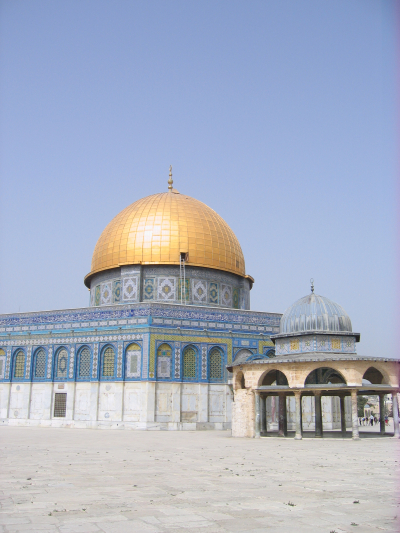
©Qalawun VR Project (Photo by Haruka USUKI)
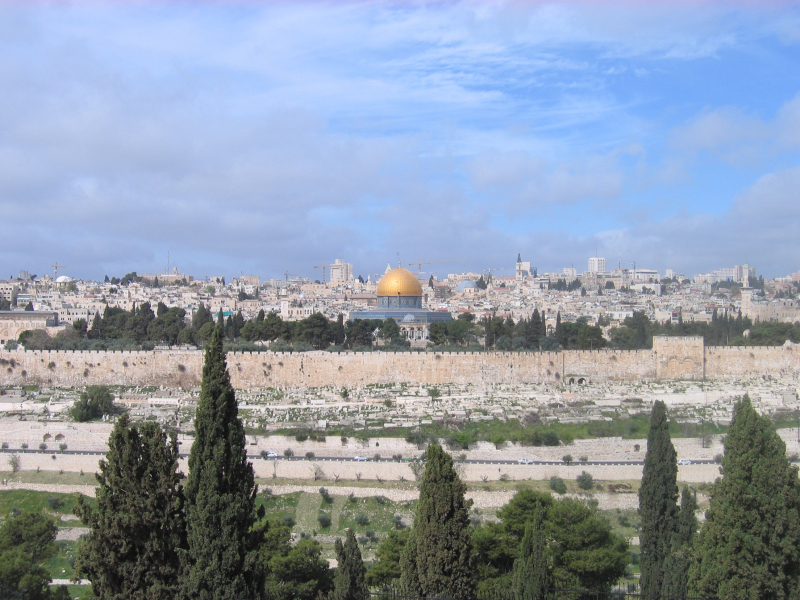
©Qalawun VR Project (Photo by Haruka USUKI)
Inside the Dome of the Rock lies a massive rock of great religious significance. In Jewish tradition, this rock is known as the place where Abraham was prepared to sacrifice his son, Isaac1. A related version of this story is also found in Islamic tradition2.
1 ユダヤ教の聖典に含まれる創世記(旧約聖書)第22章には、この出来事について書かれている。アブラハムの行為を受けて、信仰心を確認した神は使いを遣り、その行為をやめさせた。アブラハムは息子イサクの代わりに牡羊を捧げた。
2 イスラームでは、アブラハム(アラビア語でイブラーヒーム)が捧げようとしたのはイサク(アラビア語でイスハーク)ではなく、長子イシュマエル(アラビア語でイスマーイール)であるとされている(エスポズィト, 2020: 34; 小杉 2002: 山本 2020: 50)。クルアーンの整列者章100節から111節に同様の伝承があるが、名前は明記されていない。
On the other hand, in Islamic sources, the Hadith—reports of the words and deeds of the Prophet Muhammad—preserve the following account3; the Prophet is said to have made the Night Journey (called Isra’ in Arabic) from Mecca to Jerusalem and then ascended to heaven in the event known as the Mi‘raj in Arabic. According to tradition, the site of this ascension is the rock inside the Dome.
3 例えば、クルアーンの夜の旅章。
Jerusalem is regarded in Islam as the third-holiest city, after Mecca and Medina. For this reason, visiting Jerusalem has long been considered meritorious. Today, Muslims pray facing the Kaaba in Mecca. However, in the early period of Islam, Muslims prayed facing Jerusalem4.
4 礼拝の方向(キブラ)がマッカに変更されたのは、624年のことである(森, 2002; 嶋田, 2002)。
Within al-Haram al-Sharif stands the al-Aqsa Mosque, located south of the Dome of the Rock. For Muslims, the al-Aqsa Mosque is as important as—if not more important than—the Dome itself. According to Islamic tradition, it was the al-Aqsa Mosque for which the Prophet Muhammad left the Kaaba during the Night Journey . Some hadiths state that it was the second mosque established on earth, after the Kaaba6.
5 臼杵, 2002a; 大川, 2002a; 杉田, 2002.
6 山本, 2020: 34–35. ハラム・シャリーフを含むエルサレムの聖地の概要については、山本, 2020の第1章が詳しい。
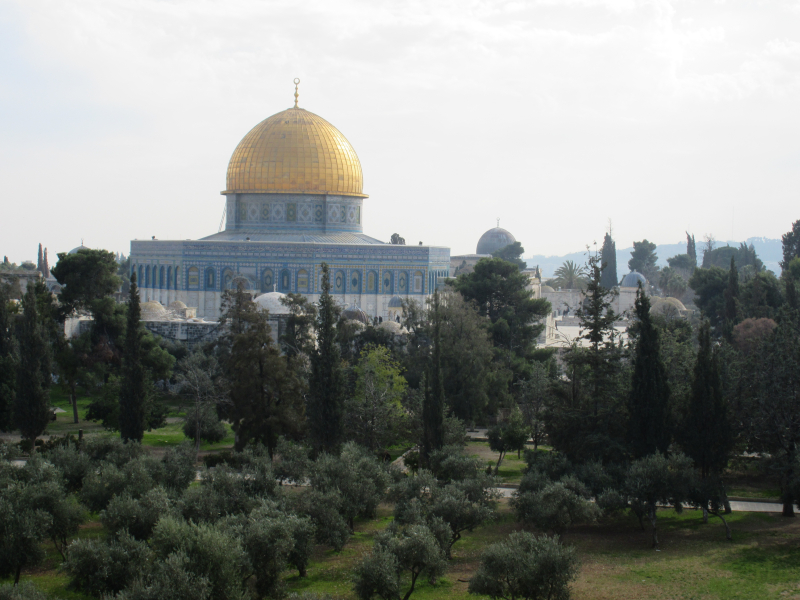
©Qalawun VR Project (Photo by Haruka USUKI)
The Dome of the Rock is said to have been completed in the late seventh century CE. Its construction was commissioned by the fifth Umayyad caliph, Abd al-Malik7. It is believed that he built the structure around the sacred rock in order to enhance Jerusalem’s religious significance. Although the Dome is now used as a place of prayer, it was originally constructed to commemorate the holy rock8.
7 エスポズィト, 2020: 15; 立山, 1993: 61.
8 深見, 2003: 64; 同, 2005: 49–50.
The Dome of the Rock is a monument dating back to the Umayyad period. While it is said to preserve much of its original form, it has undergone several renovations. For example, the distinctive blue tiles that decorate its exterior walls were added during major restoration work carried out in the Ottoman period9.
9 杉村, 2002; 立山, 1993: 61; 深見, 2002b; 同, 2005: 48.
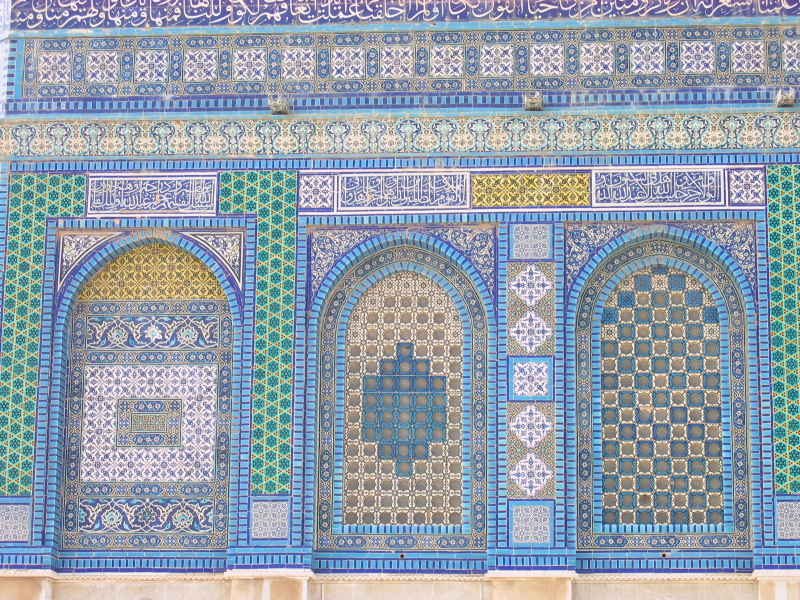
©Qalawun VR Project (Photo by Haruka USUKI)
The al-Aqsa Mosque was also constructed under the order of Abd-al-Malik and seems to have been completed around 715 CE. However, unlike the Dome of the Rock, it was damaged by fire shortly after its completion and has undergone repeated reconstructions. As a result, little of its original structure remains today10.
10 より詳しくは、立山, 199:60–62や深見, 2002aなどを参照。
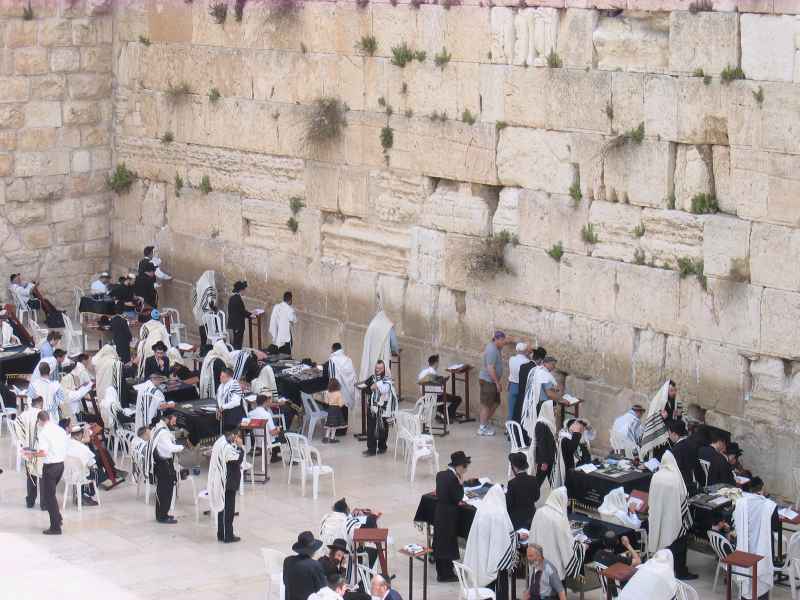
Finally, I would like to mention the wall, commonly known as the “Wailing Wall,” on the western side of al-Haram al-Sharif. It is like a tourist site, where many Jewish worshippers can be seen praying. Jewish people call the wall the “Western Wall” and regard it as a special site for prayer11. On the other hand, it is known as the “Buraq Wall” among Muslims, as it is believed to be the place where the Prophet Muhammad tied al-Buraq, the heavenly steed, during the Night Journey.
11 「西壁」は、紀元後70年にローマ軍によって破壊された神殿(第二神殿)の西側城壁の遺構である。西壁または嘆きの壁について詳しくは、立山, 1993: 32-42; 臼杵, 2002c; 山本, 2020: 37-39などを参照。
©Qalawun VR Project (Photo by Haruka USUKI)
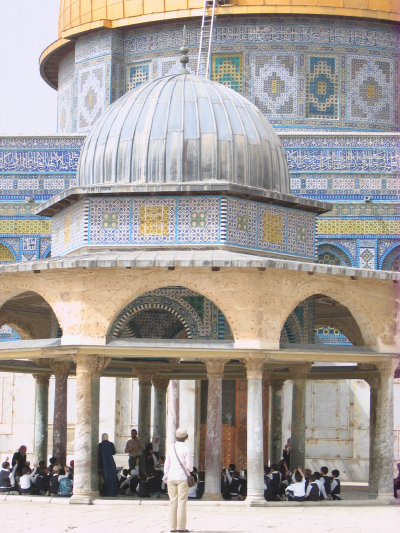
For Muslims, the Dome of the Rock is both a symbol of their faith and a source of spiritual support. At the same time, al-Haram al-Sharif is also a living space where families gather, students spend time, and people enjoy moments of rest and conversation12. However, the site is also frequently at the center of political tensions and conflicts that cause changes in its situation. For this reason, it remains a place of attention and ongoing significance13.
12 現在、ハラム・シャリーフ内は、平日の決まった時間にしか観光客は入ることができないので、訪問の際には注意が必要である。また、岩のドームとアクサー・モスク内には、イスラーム教徒でなければ入ることはできない。
13 エルサレムやハラム・シャリーフをめぐる政治的な問題については、立山, 1993や山本, 2020が詳しい。
©Qalawun VR Project (Photo by Haruka USUKI)
Bibliography
Esposito, John L., ed. 2020. Oxford Dictionary of Islam. Translation supervised by Makoto Hachioshi. Translated by Tatsuya Kikuchi and Kyoko Yoshida. Tokyo: Asakura Publishing. Originally published as Oxford Dictionary of Islam (Oxford: Oxford University Press, 2003).
Fukami, Naoko. 2002a. “Akusa-Mosuku Kenchiku [Architecture of the al-Aqsa Mosque].” Iwanami Isurāmu Jiten [Iwanami Dictionary of Islam]. Edited by Kazuo Otsuka et al. Tokyo: Iwanami Shoten, Publishers. 8.
—————. 2002b. “Iwa no Domu Kenchiku [Architecture of the Dome of the Rock].” Iwanami Isurāmu Jiten [Iwanami Dictionary of Islam]. Edited by Kazuo Otsuka et al. Tokyo: Iwanami Shoten, Publishers. 181–182.
—————. 2003. Isuramu Kenchiku no Mikata – Seinaru Isho no Rekishi [Guide to the Islamic Architecture – History of Holy Design]. Tokyo: Tokyodo Shuppan.
———. 2005. Sekai no Isurāmu Kenchiku [The World Islamic Architecture]. Kodansha Gendai Shinsho. Tokyo: Kodansha.
Japan Muslim Association. 1982. Nichi-A Taiyaku/Chukai Sei-Kuruān [Complete Interpretation of the Meaning of the Holy Quran].
Kosugi, Yasushi. 2002. “Isumāīru [Ismāʿīl].” Iwanami Isurāmu Jiten [Iwanami Dictionary of Islam]. Edited by Kazuo Otsuka et al. Tokyo: Iwanami Shoten, Publishers. 122.
Kōran [Quran]. Vol. 2. 1958. Translated by Izutsu, Toshihiko. Tokyo: Iwanami Shoten, Publishers.
Kōran [Quran]. Vol. 3. 1958. Translated by Izutsu, Toshihiko. Tokyo: Iwanami Shoten, Publishers.
Kyuyaku Seisho Sōseiki [Genesis, Old Testament]. 1956. Translated by Masao Sekine. Tokyo: Iwanami Library. Iwanami Shoten, Publishers.
Makino, Shinya. 2002. “Mīrāju [Mi ‘raj].” Isurāmu Sekai Jiten [Encyclopedia of the Islamic World]. Edited by Motoko Katakura et al. Tokyo: Akashi Shoten. 360.
Mori, Nobuo. 2002. “Kibura [Qibla].” Iwanami Isurāmu Jiten [Iwanami Dictionary of Islam]. Edited by Kazuo Otsuka et al. Tokyo: Iwanami Shoten, Publishers. 307.
Okawa, Reiko. 2002a. “Isurā [Isra’].” Iwanami Isurāmu Jiten [Iwanami Dictionary of Islam]. Edited by Kazuo Otsuka et al. Tokyo: Iwanami Shoten, Publishers. 124.
———. 2002b. “Shōten [Ascension].” Iwanami Isurāmu Jiten [Iwanami Dictionary of Islam]. Edited by Kazuo Otsuka et al. Tokyo: Iwanami Shoten, Publishers. 492.
Sato, Tsugutaka. 2002. “Mīrāju [Mi ‘raj].” Shin-Isuramu Jiten [New Encyclopedia of Islam]. Edited by Association for Islamic Studies in Japan et al. Tokyo: Heibonsha. 473–474.
Shimada, Johei. 2002. “Kibura [Qibla].” Shin-Isuramu Jiten [New Encyclopedia of Islam]. Edited by Association for Islamic Studies in Japan et al. Tokyo: Heibonsha. 195.
Sugimura, Toh. 2002. “Iwa no Dōmu [Dome of the Rock].” Shin-Isuramu Jiten [New Encyclopedia of Islam]. Edited by Association for Islamic Studies in Japan et al. Tokyo: Heibonsha. 130–131.
Sugita, Hideaki. 2002. “Miurāju [Mi ‘raj].” Iwanami Isurāmu Jiten [Iwanami Dictionary of Islam]. Edited by Kazuo Otsuka et al. Tokyo: Iwanami Shoten, Publishers. 942.
Tateyama, Ryoji. 1993. Erusaremu [Jerusalem]. Shincho Sensho. Tokyo: Shinchosha.
Usuki, Akira. 2002a. “Akusa-Mosuku Rekishi [History of the al-Aqsa Mosque].” Iwanami Isurāmu Jiten [Iwanami Dictionary of Islam]. Edited by Kazuo Otsuka et al. Tokyo: Iwanami Shoten, Publishers. 8.
———. 2002b. “Iwa no Dōmu [Dome of the Rock].” Iwanami Isurāmu Jiten [Iwanami Dictionary of Islam]. Edited by Kazuo Otsuka et al. Tokyo: Iwanami Shoten, Publishers. 181.
———. 2002c. “Nageki no Kabe [Wailing Wall].” Iwanami Isurāmu Jiten [Iwanami Dictionary of Islam]. Edited by Kazuo Otsuka et al. Tokyo: Iwanami Shoten, Publishers. 699–700.
Yamamoto, Kensuke. 2020. Seichi no Funso to Erusaremu Mondai no Shoso—Isuraeru no Senryo Heigo Seisaku to Paresuchina-jin [The Conflict of the Holy Land and Various Aspects of the Jerusalem Issue: Israeli Occupation/Annexation and Palestinians]. Tokyo: Koyo Shobo.