Madrasa – Intellectual Transmission in the Medieval Islamicate World
Madrasa, meaning “place of study” in Arabic, denotes an educational institution that offers instruction in various subjects, including Islamic law. It seems that madrasas began to be established in Khorasan, Northeastern Iran, in the tenth century as a new system that provided dedicated spaces and a variety of services for educational activities previously held in mosques. In the eleventh century, Niẓām al-Mulk, vizier of the Seljuk Dynasty (1038–1194), established Niẓāmiyya Madrasas in major cities, including Baghdad. Since the twelfth century, madrasas have been constructed in various places in Syria and introduced to Ayyubid Egypt (1169–1250) during the latter half of the century. In the thirteenth and fourteenth centuries, madrasas were established across a wide region, from North Africa to Anatolia and Iran, and many were built in Mamluk Egypt and Syria1. Even today, we can also see the madrasas built during the Mamluk period in Old Cairo, where the Qalāwūn Complex is located 2.
1 Berkey, 1992: 6–9; 谷口, 2011: 62–63, 65–66; 湯川, 2009: 70–71.
2 Behrens-Abouseif, 2007: 119–121, 132–143, 152–156, 201–213, 225–230, 239–244, 255, 259–260, 298; Berkey, 1992: 61, 69–70; Petry, 1981: 330–333.
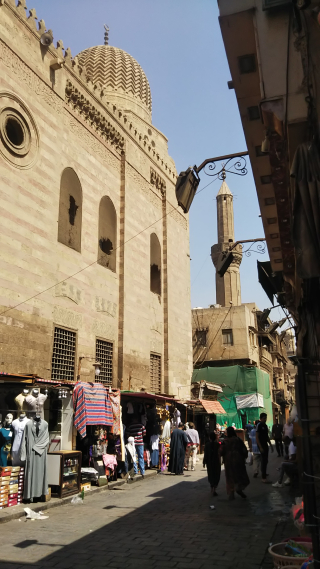
(Cairo, September 5, 2019. Photo by the author)
©Qalawun VR Project
These madrasas were usually founded through private donations by prominent individuals – such as sultans, mamluks, merchants, and scholars – and their families, rather than as state-sponsored projects3. The founders intended not only to leave property to their descendants by appointing them as nāẓir (administrator), responsible for the management of waqf (endowed) property and its profits, but also to commemorate their benefactions by building a madrasa named after them4. In addition, the military elite also established madrasas to gain support from ulama by protecting them, as well as because of their personal interest in Islam and scholarship5. Concerning the appointment of professors in the madrasas, the founders and nāẓirs had the authority to appoint them, although qāḍīs (judges) or sultans sometimes exerted influence over these appointments6. In practice, scholars who held professorial positions often passed their positions to a relative, disciple, or friend upon retirement7.
3 Berkey, 1992: 61.
4 Behrens-Abouseif, 2007: 12; Berkey, 1992: 128–142; Miura, 2015: 24; 谷口, 2011: 68–69; 三浦, 1995, 30, 34.
5 Berkey, 1992: 101; Miura, 2015: 23–24; 三浦, 1995: 30.
6 Berkey, 1992: 96–107; Chamberlain, 1994: 94–97.
7 Berkey, 1992: 112–113, 119–127; Chamberlain, 1994: 94–95.
Regarding the facilities of madrasas, large institutions typically included lecture halls, a prayer hall, and residential quarters for students and professors arranged around a central courtyard. In addition, some madrasas annexed a library, a kuttāb (an elementary educational institution teaching how to read and write the Quran), and the tomb or mausoleum of the founder8. In each madrasa, there were various positions other than the professor giving a lecture and the nazir: imām (prayer leader), khaṭīb (preacher), muʾadhdhin (person who proclaims the call to the daily prayer), reciter of the Quran and hadith (traditions of the Prophet Muhammad), and gatekeepers9. There were at most around ten professors and several hundred regular students in the largest madrasas, while there were about ten students in the small ones. No tuition fees were charged, and students received a daily allowance, meals, seasonal clothing, and stationery10. On holidays, special meals including meat dishes were served11. Many of the students seem to have been in their late teens or early twenties, but no age limit or term of study was specified. Generally, madrasas only accepted male students12.
8 Miura, 2015: 29–32; 谷口, 2011: 63; 三浦, 1995: 33–34.
9 Berkey, 1992: 62–66; Miura, 2015: 34–36;三浦, 1995: 36.
10 谷口, 2011: 63–65; 長谷部, 2004, 63; 湯川, 2009: 74–76.
11 長谷部, 2004, 62–65.
12 谷口, 2011: 63–65; 湯川, 2009: 74.
In contrast, women could not become professors or students at madrasas, though they could build mosques and madrasas and manage those establishments13. It seems that women’s education took place at home or in private spaces14. In addition, the transmission of the hadith placed greater importance on female transmitters, who generally had a longer life expectancy than men, because the fewer transmitters there were, the greater value it gained. There were also cases in which a woman who inherited the hadith became a transmitter when she became older15. However, no historical records have proved the actual participation of most women in scholarship and educational activities. Furthermore, historical descriptions of female hadith transmitters appear to emphasize their piety by highlighting their connection to the Prophet through their transmissions16.
13 Berkey, 1992: 162–165; Igarashi, 2019.
14 Berkey, 1992: 165–175; 谷口, 2011: 65.
15 Berkey, 1992: 175–181; Sayeed 2013; Davidson, 2020: 174–201.
16 Davidson, 2020: 174–201.
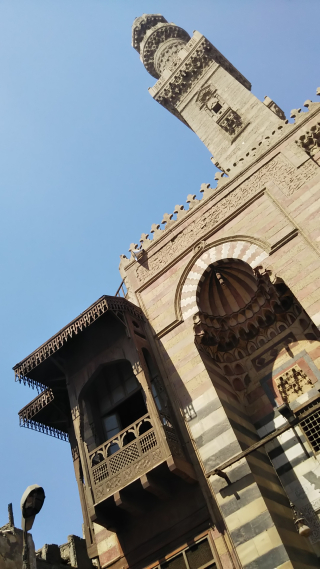
(Cairo, September 5, 2019. Photo by the author)
©Qalawun VR Project
Next, let us look at the subjects taught in madrasas. For example, at the madrasa of Sultan Ḥasan (r. 1347–51 and 1354–61), various lectures, including law, hadith, Quranic exegesis, Arabic, medicine, and astrology, were delivered17. No specific curriculum existed, and the lectures primarily consisted of reciting the professor’s writings or texts for which he had a teaching license18. The reasons are as follows. First, as the Arabic alphabet is an abjad, with only consonants required to be written and few vowel indicators are written, the information can be transmitted correctly only with recitation. Second, in the Arabian Peninsula, it has been regarded that the Quran should have been recited from memory, following the oral culture traditions of the pre-Islamic period19. Therefore, oral culture remained important even after the books had become widespread and coexisted with written tradition20. Moreover, there was no diploma issued by the madrasa, but a license (ijāza) was issued under the name of each professor because the madrasas laid emphasis on personal transmission from professor to student21.
17 Berkey, 1992: 67–69; 谷口, 2011: 63–64; 長谷部, 2004, 58.
18 谷口, 2011: 34–36, 64–65.
19 谷口, 2011: 37–38.
20 Hirschler, 2012: 12–17; 谷口, 2011: 36–37.
21 Chamberlain, 1994: 82, 89: 谷口, 2011: 38–39, 65. イジャーザの発展やイジャーザの種類については、Davidson, 2020: 108–151参照。
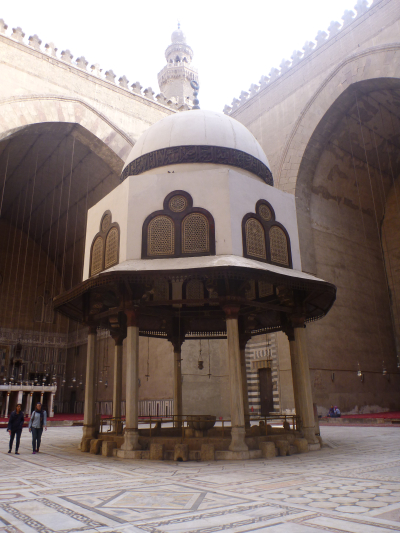
(Cairo, February 21, 2013. Photo by the author)
©Qalawun VR Project
Furthermore, educational activities were not confined to madrasas; they also took place in mosques, khānqāhs (Sufi lodges), and private residences22. According to research on educational activities in Mamluk Cairo, distinctions among the terms denoting educational establishments, including madrasa, mosque, and khānqāh, began to fade by the 1330s, and various terms came to denote the same institution. This is because the education emphasized personal transmission from teacher to student; therefore, the greater emphasis was placed on the person from whom the student learned than the institution in which they learned. Many madrasa professors also taught students outside madrasa, and there were study circles organized by individual scholars. Thus, those educational activities did not emphasize place and had casual and flexible features based on personal transmission23.
22 Berkey, 1992: 16, 50–60; Chamberlain, 1994: 80, 84; Tibawi, 1962: 236; 谷口, 2011: 65–66.
23 Berkey, 1992: 16, 50–60, 85–88.
In addition, lectures were open not only to regular students of madrasa but also to staff members—including muʾadhdhins and gatekeepers—as well as the general public24. Furthermore, mosques and madrasas regularly held gatherings for listening to the recitation of a book. For example, the book History of Damascus, written in the twelfth century, were recited by professional reciters under the supervision of Ibn ʿAsākir, the author and his family, including his son and nephew, in various places, including the Umayyad Mosque in Damascus, and hundreds of these gatherings were held between the late twelfth century and the early thirteenth century. The audience of gatherings included artisans, merchants, children, women, servants, and military, as well as scholars, which indicates that the popularization of knowledge progressed during that period25.
24 Berkey, 1992: 198–201.
25 Hirschler, 2012: 32–81.

(Cairo, September 5, 2019, photo by the author)
©Qalawun VR Project
Bibliography
Akiba, Jun. 1995. “Berkry, Jornathan: The Transmission of Knowledge in Medieval Cairo: A Social History of Islamic Education.” Toyo Gakuho 77: 156–164. (In Japanese)
Behrens-Abouseif, Doris. 2007. Cairo of the Mamluks: A History of the Architecture and Its Culture. Cairo: The American University in Cairo Press.
Berkey, Jonathan. 1992. The Transmission of Knowledge in Medieval Cairo: A Social History of Islamic Education. Princeton: Princeton University Press.
Chamberlain, Michael. 1994. Knowledge and Social Practice in Medieval Damascus, 1190–1350. Cambridge: Cambridge University Press.
Davidson, Garrett A. 2020. Carrying on the Tradition: A Social and Intellectual History of Hadith Transmission across a Thousand Years. Leiden and Boston: Brill.
Hasebe, Fumihiko. 2004. “Chūsei Ejiputo Toshi no Kyūhin: Mamurūku-chō Surutān no Madorasa wo Chūshin ni [Poverty Relief in Medieval Egypt: Cases of the Sultan Madrasas during Mamluk Period].” Chūsei Kanchichūkaiken Toshi no Kyūhin [Poverty Relief in the Medieval Mediterranean Cities]. Tokyo: Keio University Press. 45–89. (In Japanese)
Hirschler, Konrad. 2012. The Written Word in the Medieval Arabic Lands: A Social and Cultural History of Reading Practices. Edinburgh: Edinburgh University Press.
Igarashi, Daisuke. 2019. “Father’s Will, Daughter’s Waqf: A Testamentary Waqf and Its Female Founder/Administrator in Fourteenth-Century Egypt.” Orient 54 (2019): 41–53.
Miura, Toru. 1994 “Michael Chamberlain: Knowledge and Social Practice in Medieval Damascus, 1190–1350.” Toyo Gakuho 79: 120-128. (In Japanese)
———. 1995. “Damasukusu no Madorasa to Wakufu [Madrasa and Waqf in Damascus].” Sophia Journal of Asian, African, and Middle Eastern Studies 13: 21–62. (In Japanese)
———. 2015. Dynamism in the Urban Society of Damascus: The Ṣāliḥiyya Quarter from the Twelfth to the Twentieth Centuries. Leiden: Brill.
Petry, Carl F. 1981. The Civilian Elite of Cairo in the Later Middle Ages. Princeton: Princeton University Press.
Sayeed, Asma. 2013. Women and the Transmission of Religious Knowledge in Islam. Cambridge: Cambridge University Press.
Taniguchi, Junichi. 2011. Seinaru Gakumon, Zokunaru Jinsei: Chūsei no Isurāmu Gakusha [Holy Scholarship and Worldly Life: Medieval Islamic Scholars]. Tokyo: Yamakawa Shuppansha. (In Japanese)
Tibawi. Abdul Latif. 1962. “Origin and Character of ‘al-madrasah.’” Bulletin of the School of Oriental and African Studies 25, 1/3 (1962): 225–238.
Yukawa, Takeshi. 2009. Isurāmu Shakai no Chi no Dentatsu [Transmissions of Knowledge in the Islamic Society]. Yamakawa Shuppansha.